How to Write Better Equine Chiropractic SOAP Notes
SOAP notes are the backbone of clinical documentation. For equine chiropractors, thorough SOAP notes aren't just good practice—they're essential for credibility, compliance, and continuity of care.
But let's be real: writing detailed SOAP notes for every horse you see is time-consuming. Many equine chiropractors rush through notes or keep them vague. That's a mistake. Clear, specific SOAP notes:
- Justify the treatment you provided
- Create a legal record if disputes arise
- Give you a clear baseline to track progress
- Help referrals and collaborating vets understand your findings
- Support vet authorization requirements in regulated states
This guide covers what makes an excellent SOAP note, plus strategies (including AI assistance) to write them faster without sacrificing quality.
SOAP Note Anatomy
SOAP stands for Subjective, Objective, Assessment, and Plan. Each section serves a specific purpose:
Subjective (S)
The subjective section captures what the owner or trainer told you about the horse's condition, behavior, and performance.
Good subjective sections include:
- Chief complaint: What's the owner concerned about?
- Onset: When did the problem start?
- Pattern: Is it worse with certain work or activities?
- Prior treatment: Has the horse seen a vet or trainer about this?
- Medical history: Any previous injuries, lameness, or conditions?
- Current work: What does the horse do? (dressage, jumping, trail, ranch work, etc.)
Example:
"Warmblood mare, 8 years old, English pleasure and low jumps. Owner reports occasional stumbling in right front, particularly on leads to the left. Started 2 weeks ago after a jumping lesson. Horse has history of right hind lameness 3 years ago (resolved). No prior chiropractic care. Vet cleared for lameness. Owner seeking performance improvement."
Objective (O)
The objective section is purely what *you* observed and assessed. This is measurable, clinical, and specific. No interpretation here—just facts.
Good objective sections include:
- Posture and gait: What did you observe while the horse moved?
- Palpation findings: Which vertebrae or joints had restrictions, soreness, or misalignment?
- Range of motion: Which directions are restricted or limited?
- Muscle tone: Areas of tension, atrophy, or asymmetry?
- Other findings: Hoof balance, saddle fit, behavioral signs?
Example:
"Walk and trot gaits asymmetrical; right front stride shorter than left. Palpation: Subluxation at T12 (spinous process prominence, restricted lateral flexion). Tightness in right suprasinatus and infrasinatus. Reduced extension in right shoulder. Mild atrophy of right hind gluteal muscles. No heat or swelling. Posture: Slightly right-loaded. Rib palpation: Mild soreness right side, ribs 12-13."
Assessment (A)
The assessment section is where you interpret the objective findings and explain what you think is happening. This is your professional opinion based on the clinical presentation.
Good assessment sections:
- Connect findings to the chief complaint
- Identify subluxations and restrictions
- Explain likely causes or contributing factors
- Reference anatomy when relevant
- Consider the whole-horse picture (posture, muscle, movement, discipline demands)
Example:
"Right shoulder subluxation with compensatory right-side rib restriction and left-side extension limitation. Likely secondary to acute trauma (jumping landing) with subsequent protective muscle guarding in right forelimb stabilizers. Reduced right hind engagement suggests secondary compensation pattern. T12 subluxation may reflect gait asymmetry or uneven loading. No evidence of lameness; findings consistent with acute mechanical restriction rather than structural injury."
Plan (P)
The plan section outlines what you did, why, and what you recommend going forward.
Good plan sections include:
- Treatment provided: Which techniques, which areas, how many sessions?
- Rationale: Why this treatment addresses the findings?
- Outcomes: Any immediate improvements or client education?
- Recommendations: Stretching, rest, follow-up appointments?
- Timeline: When should the owner expect improvement? When's the next check-in?
Example:
"Provided adjustments to T12 (with soft-tissue prep), right shoulder complex, and rib cage. Mobilized restricted right shoulder extension. Owner educated on post-treatment stretching protocol (encouragement of lateral flexion for 24-48 hours post-treatment, light walking only). Recommend 3-4 sessions over 2 weeks; recheck in 5-7 days. Monitor gait symmetry and right forelimb landing. Recommend saddle fit evaluation if symptoms persist. Follow-up contact in 3 days to assess recovery."
Common Mistakes to Avoid
Too vague. "Subluxations noted" doesn't tell you which vertebrae, which direction, or how restricted. Be specific.
Too much subjective. Your opinion of the owner's horsemanship, equipment choices, or riding style doesn't belong in SOAP notes. Stick to clinical findings.
Inconsistent terminology. Pick anatomical terms and use them consistently. "Subluxation at T6" not "T6 is out."
No objective findings. If you write "responded well to treatment" without documenting what was actually found, your note loses credibility.
Unclear plan. Don't assume the reader knows what you did or why. Spell it out.
SOAP Note Templates for Equine Work
Here's a template you can adapt:
SUBJECTIVE:
- Chief complaint: [what owner reported]
- Onset: [when it started]
- Pattern: [how symptoms present]
- Medical history: [relevant prior conditions]
- Current discipline/work: [what the horse does]
- Prior treatment: [vet visits, farrier, trainer, etc.]

OBJECTIVE:
- Gait: [walk/trot/canter observations]
- Posture: [stance, weight distribution, asymmetry]
- Palpation findings: [subluxations, restrictions, tenderness]
- Range of motion: [restricted directions]
- Muscle: [tone, atrophy, tightness]
- Other: [conformation, saddle fit, behavioral signs]

ASSESSMENT:
- Primary findings: [subluxations and restrictions]
- Contributing factors: [likely cause, compensation patterns]
- Relationship to chief complaint: [how findings explain symptoms]
- Prognosis: [expected recovery timeline]

PLAN:
- Treatment provided: [techniques and areas]
- Rationale: [why this treatment addresses findings]
- Owner instructions: [stretching, activity, restrictions]
- Recommendations: [saddle fit, vet follow-up, farrier, etc.]
- Follow-up: [when to recheck, when to contact owner]
Assisted SOAP Drafting
Purpose-built practice-management software can reduce repetitive SOAP entry while keeping the practitioner in control of the clinical record:
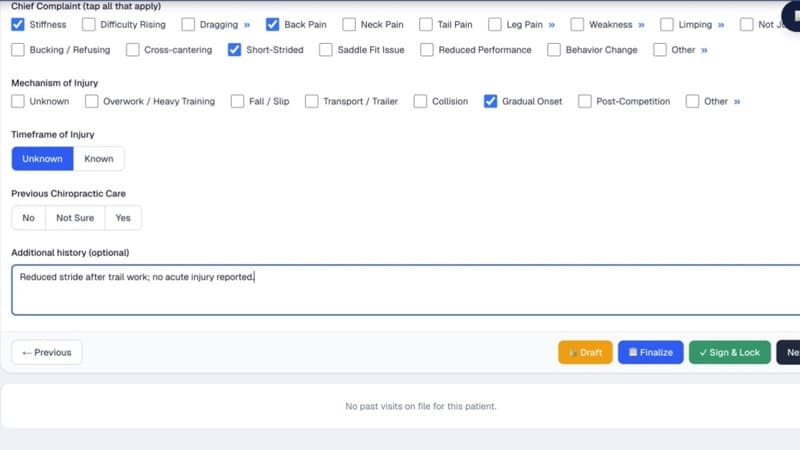
In ChiroStride, the workflow works like this:
1. After your assessment, you quickly select 3-5 relevant clinical observations from templated chips: "T12 subluxation," "Reduced shoulder extension," "Rib tightness right side," etc.
2. The software organizes your selections and practitioner-provided text into an editable SOAP draft. Optional online transcription can add observations you dictate.
3. You review it, edit any sections, and save.
The software does not replace your clinical judgment or independently supply clinical facts. The treating practitioner remains responsible for the content, terminology, completeness, and final approval.
Structured selections and optional transcription can reduce repetitive entry, but every draft still requires practitioner review for accuracy, completeness, and appropriate terminology. See Chiro Stride's equine documentation workflow.
Implementation Tips
Develop a habit. Write SOAP notes *immediately* after treatment, while your observations are fresh. Waiting until the evening leads to vague, incomplete notes.
Be consistent. Use the same format, terminology, and level of detail for every patient. This makes it easy to review your own notes and compare visits.
Focus on specific findings. Don't write "some tightness"—write "moderate tension in right trapezius extending to neck." Specific beats vague every time.
Link to recommendations. If you recommend a saddle fit evaluation, explain why (e.g., "uneven rib contact may reflect saddle asymmetry").
Track outcomes. When the owner returns, note improvements or changes from the prior visit. This reinforces your credibility and lets you adjust your approach.
Vet collaboration. If you're working with a referring vet, SOAP notes are your communication tool. Clear notes build trust and help the vet understand your findings.
Compliance and Authorization
In states that require veterinary authorization, your SOAP notes are part of the compliance record. Clear, detailed notes:
- Demonstrate the medical necessity of treatment
- Show you're not practicing veterinary medicine
- Provide documentation if the vet or board ever audits your work
Don't skimp on SOAP notes as a compliance strategy. They're your best defense.
The Bottom Line
SOAP notes take discipline to write well, but they're worth the effort. They're a legal record, a clinical baseline, and a communication tool with vets and owners.
If you're currently rushing through notes or skipping them, start small: commit to writing one detailed SOAP note per day, using the template above. You'll get faster with practice.
And if you're not using software that helps you write notes faster, consider whether manual documentation is the best use of your clinical time. Purpose-built tools can reduce repetitive administrative work while leaving clinical review and approval with the treating practitioner.