Why Animal Chiropractors Need Specialized Software (Not Vet or Human Chiro Tools)
There's a tempting shortcut when you're starting an animal chiropractic practice: use existing software built for veterinarians, or borrow tools from human chiropractors.
It seems logical. Both involve animals and patient care, right?
It doesn't work. Animal chiropractors have a unique workflow that neither veterinary software nor human chiropractic software was designed for. And trying to force your practice into a tool built for someone else's workflow is like wearing someone else's shoes—uncomfortable, inefficient, and eventually painful.
This guide explains why, using real examples. By the end, you'll understand exactly what makes animal chiropractic practices different, and why specialized software isn't a luxury—it's a necessity.
The Fundamental Differences
Let's start with what makes animal chiropractic work distinct:
1. Field-Based vs. Clinic-Based
Human chiropractors work in offices. Patients arrive, check in at a desk, go to a treatment room, pay at the desk, leave. The software is built around this fixed-location workflow.
Veterinarians work in clinics or barns, but they're diagnosing and treating many species for many conditions. One patient visit might involve anything from vaccines to surgery.
Animal chiropractors spend half their time in the field: barns, arenas, ranches, client locations. You're treating one specific condition (musculoskeletal/spinal issues) across multiple species. You need to work without internet, take detailed notes on your phone, and manage clients who expect you to show up on *their* schedule.
Vet software assumes you're in a clinic. Human chiro software assumes you have a front desk. Neither handles field-based practice.
2. Multiple Species with Species-Specific Anatomy
Human chiropractic software has one anatomical model: human spine. Every template, every form, every assessment tool is optimized for humans.
Veterinary software handles *all* animals: dogs, cats, horses, cattle, exotics, and everything in between. So the anatomy is generic—simple species selectors, but no specialized workflows for specific animals.
Animal chiropractors specialize. You might work primarily with horses and dogs. You need species-specific intake forms (a horse's discipline is different from a dog's activity level). You need spinal assessment tools designed for equine anatomy, canine anatomy, etc. You need terminology that matches your specialty.
Generic software forces you into broad categories. Specialized software lets you be specific.
3. Offline First, Sync Later
Both vet and human chiro software assume reliable internet. They're cloud-based, real-time, and designed for connectivity.
Animal chiropractors work in places with no cell signal. You need offline functionality as the default, not a feature.
This is non-negotiable. You can't be stuck in a barn without the ability to document your patient, take notes, or process consent forms. You need everything cached locally, then synced when you reconnect.
Vet software and human chiro software treat offline mode as an edge case (if they support it at all). For animal chiropractors, offline is the norm.
4. SOAP Notes for Specific Conditions
Human chiropractors write SOAP notes, but typically for musculoskeletal conditions treated in an office setting. Their software has templates optimized for that.
Veterinarians write clinical notes, but they're often diagnostic (what's the disease?) rather than assessment-based. They're not typically focused on SOAP-style documentation.
Animal chiropractors use SOAP notes heavily—Subjective, Objective, Assessment, Plan. But the context is field-based treatment of spinal/musculoskeletal issues. You need SOAP templates optimized for chiropractic assessment, not general vet notes or human-centric documentation.
Specialized software has SOAP templates that match your workflow. Generic tools don't.
5. Vet Authorization Tracking
Vet software is built *by* vets, *for* vets. It doesn't understand the vet authorization requirement from the *chiropractor's* perspective.
Human chiro software doesn't even consider vet authorizations—they're not relevant to human practice.
Animal chiropractors in regulated states *have* to manage vet authorization. You need to request it, track responses, monitor expiration dates, and have a paper trail for compliance.
Specialized software builds this into the core workflow. Vet software treats it as an edge case (if at all). Human chiro software ignores it completely.
6. Owner Communication and Field Updates
Human chiropractors send email newsletters and appointment reminders. Clients come to the office.
Veterinarians see patients at the clinic and send prescriptions via mail or pharmacy.
Animal chiropractors send forms via text, get e-signatures on consent, send progress photos to owners, and provide updates from the field. Your clients are managers, trainers, and owners who need visual documentation (photos) and regular updates.
This workflow is unique to field-based animal practice. Vet software doesn't prioritize it. Human chiro software isn't built for it.
Real-World Comparison
Let's walk through a typical scenario with each type of software:
Scenario: New Equine Patient
With Generic Vet Software (e.g., Cornerstone, ezyVet):
1. Create a new patient record. Choose "horse" from species dropdown (very basic).
2. Intake form is generic (no discipline, training level, performance expectations).
3. You manually enter the owner's info, vet info, and history.
4. No templates for equine SOAP notes—you write free-form.
5. Vet authorization? Not a built-in process. You email the vet manually.
6. No offline access in the field.
7. You're fighting the software's veterinary workflows.
With Human Chiro Software (e.g., ChiroTouch, Kareo):
1. Create patient record. Select human or... wait, these are built for humans. No horse option.
2. You select "other" and work around the system.
3. Intake form is designed for human patients (injury descriptions, human disciplines, etc.).
4. SOAP templates are for human musculoskeletal conditions, not equine work.
5. No concept of vet authorization.
6. Software expects office-based workflow (desk check-in, treatment room, billing at desk).
7. You're fighting a system built for a completely different practice type.
With Specialized Animal Chiro Software (e.g., Chiro Stride for equine or Chiro Stride for canine):
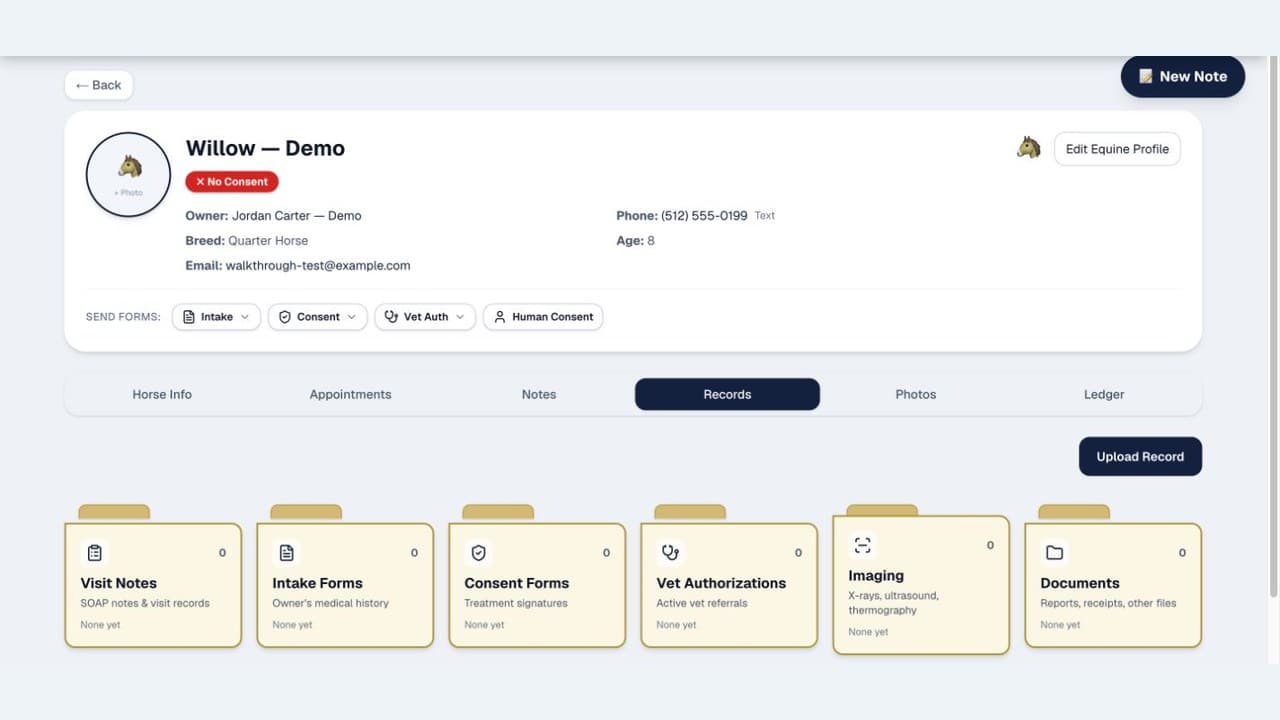
1. Create patient record for horse. Equine-specific fields appear automatically.
2. Intake form is equine-tailored (breed, discipline, training level, performance goals).
3. SOAP note template is optimized for equine spinal assessment.
4. Vet authorization workflow is built in: request, track response, monitor expiration.
5. Digital forms work offline; sync when you reconnect.
6. Owner communication tools include photo sharing, progress updates, SMS.
7. You're using a tool built for your exact workflow.
Which one saves you time and frustration? The answer is obvious.
The Real Cost of Wrong Software
Using the wrong software isn't just inconvenient—it costs you:
Time: You spend hours forcing your workflow into a system not built for you. Manual workarounds. Data entry to bridge systems. Chasing missing information.
Compliance risk: Vet authorization tracking is weak or manual. SOAP notes aren't standardized. You might miss an expiration date or authorization requirement.
Data loss: Without offline functionality, field notes are lost if you lose signal. Forms aren't accessible in the barn.
Frustration: Every day you use software that doesn't match your workflow, you get frustrated. That builds up.
Cost: You're paying for features you don't need while missing features you do need. And you're paying for your inefficiency—hours wasted per week.
Even a $60/month tool that wastes 5 hours per week is costing you far more than the subscription price.
What Specialized Animal Chiro Software Includes
Here's what you should look for in software built for animal chiropractors:
- Species-specific intake and assessment tools (equine, canine, feline, bovine, etc.)
- Offline-first architecture with automatic sync
- SOAP note templates optimized for chiropractic assessment
- Vet authorization workflow (request, track, expire, compliance report)
- Digital forms with e-signature support
- Field-friendly interface optimized for mobile/tablet
- Photo documentation with before/after comparison
- Owner communication tools (SMS, email, progress updates)
- Invoicing and payment processing with QuickBooks integration
- Analytics and reporting for your practice
- Scheduling and reminders for appointments
A tool built for animal chiropractors includes all of these as core features. Generic tools have some of them, poorly.
The Integration Advantage
Another benefit of specialized software: everything talks to each other.
When you're using vet software + human chiro software + scheduling app + invoicing app + form tool, you're constantly moving data between systems. Forms don't auto-populate records. Invoices don't connect to scheduling. Vet authorizations aren't tracked across systems.
Specialized software integrates all of this. Forms populate records. Records sync to invoices. Authorizations are tracked from request to expiration. Everything is connected.
This integration saves hours per week and eliminates data-entry errors.
The Path Forward
If you're currently using generic software (or no software), don't feel bad. Most animal chiropractors start with what's available, then realize it doesn't work.
The question isn't whether you need specialized software. The question is how soon you'll switch. If you're still managing patient records with spreadsheets, see exactly what that approach is costing you.
Every week you spend with the wrong tool is a week of inefficiency, frustration, and compliance risk.
Specialized software isn't an upgrade—it's a necessity for running a modern, field-based animal chiropractic practice.
Your workflow is unique. Your software should be too.